

This article was inspired by “Preparing Students for an AI Workforce,” a June 10 workshop from the Texas Computer Education Association’s 2026 virtual conference. For more on the conference, see our blog post The New World of Educational AI.
Humans have a longstanding love-hate relationship with technology. From the first mass-production factory to the latest AI-powered smartphone app, every new innovation has been indiscriminately embraced by some people—while others make dire predictions about humanity’s future.
Today’s high school and college students have extra cause for mixed feelings. On the one hand, they were brought up with smartphones and can’t imagine living without a world of data in their pockets. On the other hand, these young people will soon be entering the job market, and many are haunted by the question: Should we worry that AI will make human employees obsolete?
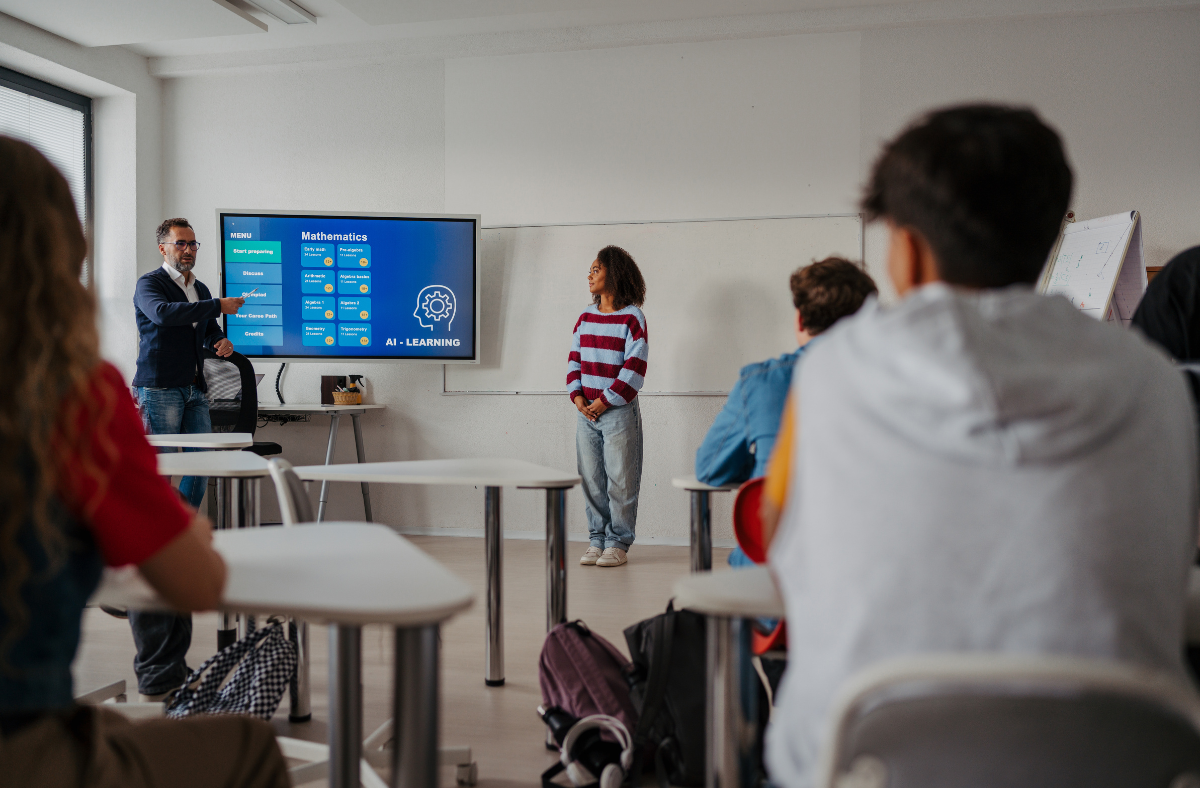
Artificial Intelligence Meets Human Intelligence
The short answer to that question is a definite No. The longer answer lies in the core differences between artificial and human intelligence.
- AI’s main strength is its speedy organizing of information. When a question or other “prompt” is entered, the AI accesses a vast collection of human-originated data; makes logical connections between the prompt and various data items; then blends the connections into a likely answer, translates that into plain language, and displays or announces it. All in a matter of seconds.
- AI’s fundamental weakness is that without human prompting, it cannot properly evaluate its assertions. AI can be wrong: so can humans. Humans, however, can recognize their own fallibility, reconsider their own assumptions, and generate entirely new ideas.
- Humans also have real-world personal experience to draw on. AI, having only data that simulates the three-dimensional world, is not well equipped for adapting to unpredictable situations. (See this recent news clip on Waymo’s difficulties teaching its robot taxis to recognize highway construction zones.)
It should be noted that public-education models have frequently shortchanged human intelligence by focusing on accepted facts, memorization, and strict task parameters. AI works on a similar model, so it’s not surprising if students worry that “AI will take all the good jobs.” Actually, there’s no reason it should. A human worker who understands critical thinking and soft skills is well prepared to work with AI for optimal results.
Teammates, Not Competitors
So, how do humans work best with AI? Here are some tips:
- Begin with detailed, carefully-thought-out prompts. You can ask AI to “role-play” (“Answer this as a coach/professor/skeptical classmate”), or tell it what not to do (“Do not include information from [dubious source(s)]”; “Generate information for a four-paragraph summary, but do not write the summary for me”). Avoid language that suggests predetermined opinions; if you ask, “Is it true that…,” most AI systems will emphasize information that says it is true.
- Unless your question is very basic, don’t be satisfied with the first search results: follow up by seeking different viewpoints. (“What is the weakest point in this argument?” “What would [group known to represent the opposite viewpoint] say in response to this?” “Push me to defend this opinion with objective evidence.”)
- Always review AI results for “hallucinations” (false assertions) and stereotypical implications.
- When you have a “final result,” review it one more time to verify that it covers all essential points. (Ask the AI for an essential-points checklist to help with the review.)
- Whether you’re working on ad copy or a banquet menu, treat every AI-generated recommendation as a “rough draft.” Always edit the final version personally (or have a qualified coworker edit it).
- At all stages of a project, be ready to modify plans (and prompts) as needed.
- Always stay open to human input. Even with help from AI, one person can’t figure out everything alone.
In a sentence, teaming human intelligence with AI means using AI-generated information as a starting point for exercising your own creativity and individualism. This concept is sometimes called applied general intelligence (AGI) or applied co-intelligence, and it is a vital skill in today’s workforce.
Technology breakthroughs have often overemphasized “efficiency,” sometimes at the expense of recognizing human value. With wise use of AI, we can learn to be efficient and develop individual intelligence to the fullest.
P.S. AI, Human Intelligence, and Younger Students
School days will soon be here again. Many assistive technologies now use AI, which makes it a reasonable learning accommodation. Especially for neurodivergent children, it can be a big help in improving communication, encouraging independent thinking, and developing other human-intelligence skills. See these resources:
- AI and Autism
- Embracing AI for Neurodiverse Students
- Ethical Ed Tech
- How Artificial Intelligence Is Enhancing Assistive Technology to Help Students
Watch this blog for a post on “AI in the Classroom,” coming in August.