Our second article on the 2026 Consumer Electronics Show (CES). Three BridgingApps team members and one client family were there:
- Cristen Reat, BridgingApps Co-Founder and Program Director
- Tara Rocha, Digital Learning Specialist
- Alejandra “Ale” Gonzalez, Digital Navigator
- Michael, Blanka, and Sarah Brhlik (Sarah, the young-adult daughter, has Down syndrome)
“I’ve heard about CES for years, always linked to the most exciting breakthroughs in consumer electronics, robotics, and communication. As someone working in technology and AI, I was grateful for the chance to attend CES 2026.” –Michael

Today, we focus on standout items from the Show’s preliminary events and CES Stages.
CTA Foundation Health Innovation Challenge
“The CTA Foundation Innovation Challenge, presented by the WITH Foundation, asks consumer technology companies to … solve challenges faced by those with intellectual or developmental disabilities (I/DD) … This program will particularly target the needs of working age adults (18–64) who … are seeking more independence and control in their healthcare.” –From the Innovation Challenge web page
The aim of the Health Innovation Challenge was to provide companies with an opportunity to engage the IDD community in a rich discussion, and then to competitively share solutions for health technology needs. The program was on Monday morning, January 5, the day before CES officially opened. (Fun facts: This was the first major CES program to focus primarily on IDD-related technology. Over 16.5 percent of the U.S. population is estimated to have some form of IDD.)
“During the pre-competition discussion, Sarah asked, ‘What about Down Syndrome?’ It was a thrill to hear her ask a question. And it was real excitement for me, personally, to see a new focus on individuals with intellectual and developmental disabilities and their caregivers.” –Cristen
Innovation Challenge finalists:
- Winner: HapWare, a wristband that works with smart glasses to translate over twenty “nonverbal cues” for wearers with visual or intellectual/neurological disabilities. In typical conversations, around half of communication is nonverbal; so HapWare serves as an “interpreter.”
- Runner-Up: Lotus, a finger ring that allows users to control smart-home technology by simply pointing. Especially recommended for people who dislike complicated technological features: the Lotus ring works by infrared beam and magnetic switch, no apps or internet connection required.
- Cairns Health, a home radar device for people with disabilities affecting independent-living skills. Can be programmed for verbal reminders, conversational AI, and personalized health tips.
- Daivurjnt SpectrumScan, an app for users with overstimulation challenges. It uses a personalized “sensory profile” to warn of potential triggers (bright lights, ambient noise, etc.). The company founder is autistic and developed the idea to help others who struggle with sensory overload.
- Key2Enable’s AI learning platform and adaptive Key-X keyboard. Focused on early education, the technology can gamify learning, create tasks, and help teach independence skills.
- SpineX assistive technology for children with spinal-cord-related walking difficulties. The new xStep, scheduled to launch in mid-2026, is described as “a hearing aid for the spine”—painless and non-invasive.
(Note: These technologies are still in various stages of development. Check their websites for up-to-date information.)
“Sarah particularly enjoyed the ‘competition’ between the inventors. She also liked meeting the HapWare people and a gentleman from Meta.” –Blanka
“Attending together gave us a rare, comprehensive look at how accessible technologies are conceived, built, and brought to market. Hearing directly from users, parents, advocates, engineers, and investors offered a full picture of the challenges and opportunities in designing for people with disabilities.” –Michael
Accessibility Roundtable
Following the Innovation Challenge, Cristen, Tara, and Ale attended the Accessibility Roundtable on Monday afternoon. Roundtable participants included leaders from industry, government, and the disability community. The focus was on accessibility priorities in the tech ecosystem, including:
- The growing role of AI in accessibility
- How technology can support disability employment and workforce inclusion
- Updates on accessibility efforts at the Consumer Technology Association (CTA) and the Federal Communications Commission (FCC)
Accessibility Stage
During the main CES week (January 6–9), a major new attraction was the Accessibility Stage. It hosted over two dozen sessions, giving CES attendees an unprecedented opportunity to get involved.
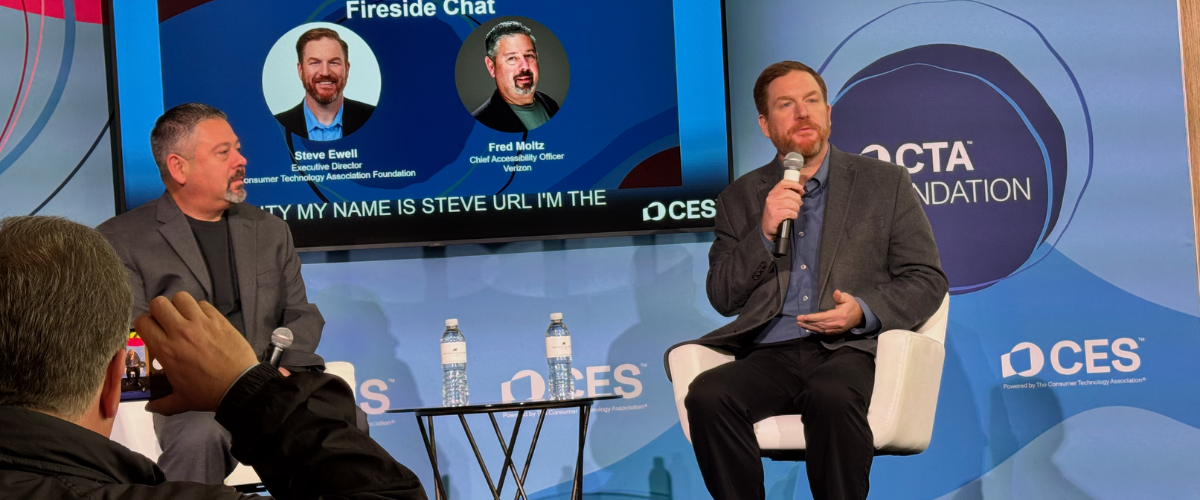
“Presented by Verizon Accessibility, this new stage [spotlighted] innovations and solutions designed to improve accessibility for all.” –From the “Guide to CES Stages” web page
“Each session included a close-up of the presenters; dedicated views of a live interpreter; large screens on either side of the stage; and a live transcription feed where a staff member in the front row transcribed presentations in real time. The setup was remarkably effective: the accessibility stage was centrally located, yet set apart enough to create its own focused space. Many sessions were filled to capacity.” –Tara
“I came away with a deeper appreciation for the thought, research, and effort the industry invests in improving people’s lives. My thanks to all the companies for their inspiring work, and to the organizers for bringing together such a diverse and committed group. I look forward to staying connected and following the developments ahead.” –Michael