Garrett Groogan is a young-adult BridgingApps client with autism: he came to us through the Comcast Digital Literacy program (Year 3 cohort) and the Compudopt laptop grant. Garrett has earned multiple Certificates of Completion for Northstar Digital Literacy courses.
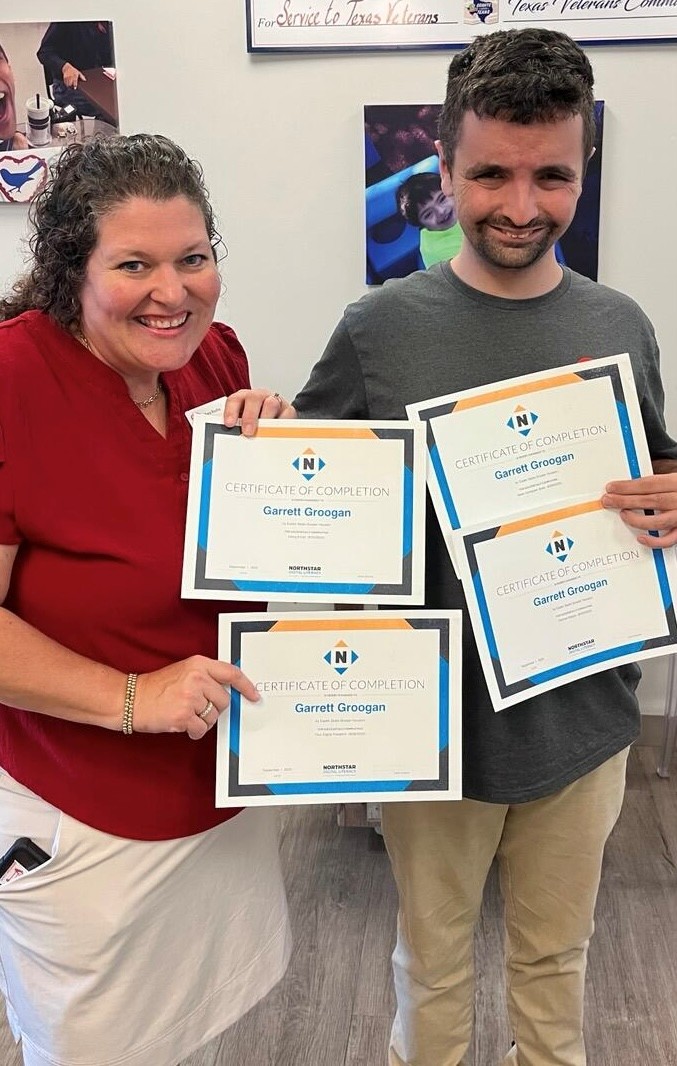
Garrett’s mother, Michelle Groogan, shares the family’s client journey in today’s post. (Both parents are media professionals with technology experience of their own.)
Q: What’s the best thing about Garrett’s having his own laptop?
Michelle: The best thing is that this device is his, not just a family or school computer. Before, he constantly was asking to use the family computer, and we were making his access contingent on good behavior and just trying to keep him off it the rest of the time, and it was such a struggle and challenge. Now, it’s a lot easier for all of us. It meant a lot to me to give him ownership of that laptop, something that really says “Garrett.”
I love the way it supports his independence with communication and with online sessions. Now he has his own Gmail account, and he knows how to go to Gmail. And how to click on an email link to a Zoom or Teams meeting.
Even though Garrett was already computer savvy, I wanted him to take the class and see what else he could learn. When I first saw the email about your digital-literacy training, my first thought was, “I wonder if Garrett could sit through a series of classes” with his executive-function challenges. I decided to call BridgingApps and ask about the program; and now, I’m so proud to really see how much more Garrett can learn on the computer. It’s helping him to be more independent and advocate for himself.
Q: What other equipment has been helpful?
Michelle: Over‑the‑ear headphones help him focus, and manage sound, in different environments. He’s always carried a pair of headphones in his backpack, because he just never knows when he might need them. Like if we’re going somewhere and he wants to get on the phone, and he knows that we won’t want to listen to it.
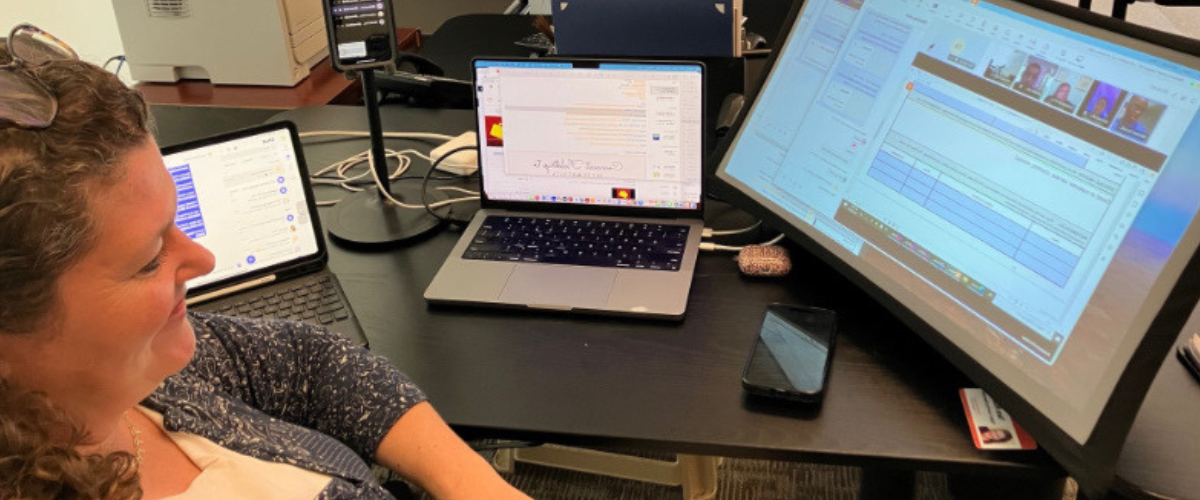
The “mirroring” feature on the extra screen [screen extender] has great potential: I can sit across from Garrett at the dining room table and monitor his work. That way, I can be a part of things without him feeling my part is obvious. He stays independent.
Q: How has all this changed his everyday life?
Michelle: Garrett’s laptop is a bridge to richer social interaction. He’s using his laptop to attend virtual communications classes every Thursday afternoon: we call them “code classes,” as in breaking the “code” of putting feelings into words. When practicing that kind of “coding,” the student doesn’t have control of his screen: the instructor does. Garrett has to use his words to tell the instructor what to do—like, he has to say, “The item in the second row, third one over.” Real, specific instructions to point something out: that’s really an important skill to learn.
Garrett also loves movies and acting out movie scripts. Now, with help from his therapist, he’s using that as a way to connect with others and practice back-and-forth conversation. The therapist will lead with something like, “George, what’s your favorite movie?” And George will say, “I love Batman.” And then the therapist will coach Garrett to say, “Oh, would you like to hear a scene from Batman?” And then he gets to do his script, which is his favorite thing to do.
The therapist has this grand idea to turn this into a “Garrett’s Movie Club” or something like that: she’s coming up with some fun names. Everybody would take their turn throwing out a movie title and seeing what Garrett might know about it.
Q: What is Garrett planning to learn next?
Michelle: We’re looking at new creative and social ways to use technology:
- Video editing: it will blend Garrett’s movie interest and his tech skills. If you ever get some sort of grant to teach editing, I’ll bring him right in for a session.
- Searching the web, and being on YouTube. Online activities that go beyond passive streaming.
- Answering email. We can start by having his coaches and teachers send him messages. Or maybe his music therapist. I can see Garrett answering a question like, “Songs I would like to sing in music therapy class.”
And I’m sure there’s other things out there that we don’t even know about yet.